The imperial cities of Morocco represent some of the most fascinating historical and cultural destinations in North Africa. Once capitals of powerful dynasties, these cities preserve magnificent palaces, ancient medinas, impressive mosques, beautiful gardens and traditions that reflect centuries of Moroccan history.
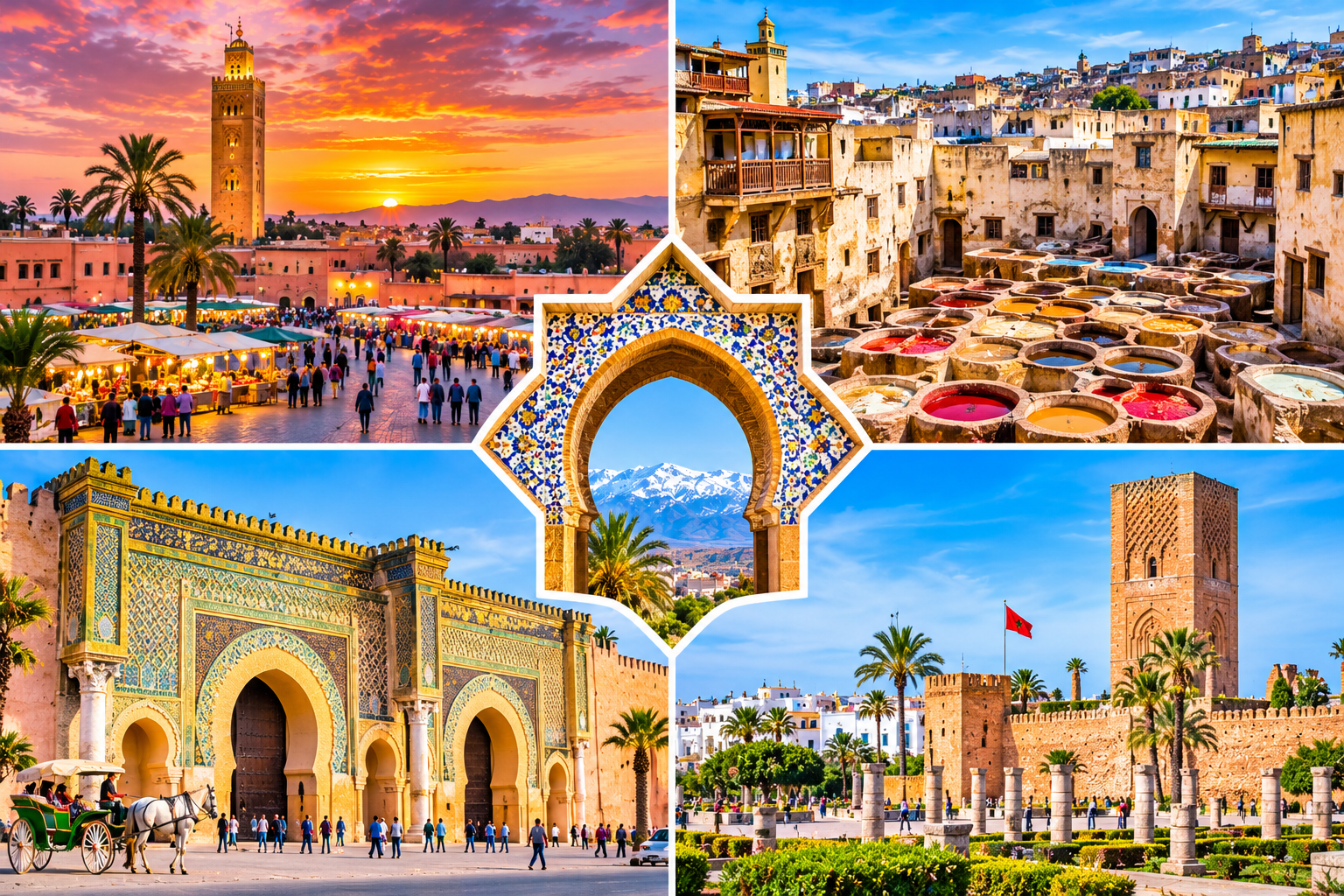
Morocco has four imperial cities: Marrakech, Fes, Meknes and Rabat. Each has its own distinctive character, but all share an important historical connection to the royal dynasties that shaped the country.
Exploring these destinations is an extraordinary journey through Islamic architecture, traditional craftsmanship and Morocco’s rich cultural heritage.
In this guide, you will discover the four imperial cities, their most important attractions, how long to spend in each destination and how to plan an unforgettable itinerary.
What Are the Four Imperial Cities of Morocco?
The four imperial cities of Morocco are:
- Marrakech: Known as the Red City.
- Fes: One of Morocco’s most important cultural and spiritual centers.
- Meknes: Famous for its impressive monuments built during the reign of Sultan Moulay Ismail.
- Rabat: The modern capital of Morocco.
These cities served as political capitals during different periods of Moroccan history.
Their importance is connected to the dynasties that ruled the country and contributed to the development of its architecture, arts, traditions and cultural institutions.
Today, the imperial cities are among the most interesting destinations for travelers who want to discover Morocco’s historical heritage.
1. Marrakech: The Imperial City of Colors and Traditions
Marrakech is probably the best-known of Morocco’s imperial cities.
Founded in the eleventh century by the Almoravids, it became an important political, economic and cultural center.
The city is known as the Red City because of the reddish tones of its historic buildings and defensive walls.
Today, Marrakech is one of Morocco’s most popular tourist destinations, combining historical monuments, traditional markets and distinctive accommodation.
Jemaa el-Fnaa Square
Jemaa el-Fnaa is the vibrant heart of Marrakech’s historic medina.
During the day, the square is filled with traders, street performers and various commercial activities.
As evening approaches, food stalls and traditional entertainment create a particularly lively atmosphere.
Walking through the square is one of the most memorable experiences in Marrakech.
Koutoubia Mosque
The Koutoubia Mosque is one of Marrakech’s most recognizable landmarks.
Built during the Almohad period, it is famous for its impressive minaret, approximately 77 meters high.
Its architectural design influenced several important buildings in the western Islamic world.
The mosque’s interior is generally not accessible to non-Muslim visitors, but the monument can be admired from outside.
Bahia Palace
Bahia Palace is a magnificent historic residence featuring beautiful courtyards, gardens and traditional decorations.
Visitors can admire intricate tilework, painted wooden ceilings and architectural details reflecting Morocco’s traditional craftsmanship.
Saadian Tombs
The Saadian Tombs contain the burial chambers of members of the Saadian dynasty.
The complex is famous for its refined decorations and the Hall of the Twelve Columns, one of its most beautiful architectural spaces.
The Medina Souks
Marrakech’s traditional markets form a maze of narrow streets and artisan workshops.
Visitors can discover carpets, ceramics, spices, lanterns and handmade products.
The Medina of Marrakech was designated a UNESCO World Heritage Site in 1985.
How long should you stay in Marrakech? At least two days, preferably three, to explore the main attractions without rushing.
2. Fes: Morocco’s Cultural and Spiritual Capital
Fes is one of Morocco’s oldest and most fascinating cities.
Founded during the eighth and ninth centuries, it became an important religious, educational and commercial center.
The city is particularly famous for its medieval medina, historic institutions of learning and traditional craftsmanship.
Fes el-Bali Medina
Fes el-Bali is the historic heart of the city.
It features a remarkable network of narrow streets, traditional markets, mosques and artisan workshops.
The Medina of Fes was included on the UNESCO World Heritage List in 1981.
Walking through its streets offers visitors an opportunity to experience traditional Moroccan activities that have been preserved for generations.
Chouara Tanneries
The Chouara Tanneries are among the city’s most famous attractions.
Traditional leatherworking techniques are still practiced here, using large vats for the treatment and coloring of leather.
The colorful tanneries can be observed from some of the surrounding terraces.
Bou Inania Madrasa
The Bou Inania Madrasa is one of Fes’s most important historic buildings.
Constructed during the fourteenth century, it is admired for its geometric decorations, carved plaster and traditional woodwork.
It represents an outstanding example of Marinid architecture.
Al-Qarawiyyin Area
The historic al-Qarawiyyin complex is associated with one of the Islamic world’s most important institutions of learning.
The mosque and surrounding buildings played a central role in the cultural development of Fes.
Access to religious areas is restricted, but the surrounding neighborhood remains an important historic attraction.
Bab Bou Jeloud
Bab Bou Jeloud is one of the most recognizable monumental gates of Fes.
Its blue and green ceramic decorations make it a popular entrance to the historic medina.
How long should you stay in Fes? Two days are recommended for exploring the medina and visiting its most important historical attractions.
3. Meknes: The Imperial City of Sultan Moulay Ismail
Meknes receives fewer international visitors than Marrakech and Fes, but it preserves a remarkable historical heritage.
The city became particularly important during the reign of Sultan Moulay Ismail in the seventeenth and eighteenth centuries.
During this period, impressive palaces, fortifications, monumental gates and infrastructure transformed Meknes into a major imperial capital.
Bab Mansour
Bab Mansour is one of Meknes’s most recognizable monuments.
This impressive gate is famous for its monumental dimensions and elaborate architectural decorations.
Located near El Hedim Square, it represents one of Morocco’s finest examples of monumental gateway architecture.
El Hedim Square
El Hedim Square is one of the main landmarks of historic Meknes.
Surrounded by traditional buildings and local businesses, it is an interesting place to observe daily life.
The square also provides access to several important historic attractions.
Mausoleum of Moulay Ismail
The Mausoleum of Moulay Ismail is dedicated to the ruler who played a central role in the development of imperial Meknes.
The complex features traditional courtyards and decorative architectural details.
Access to certain areas may vary, so visitors should check current visiting conditions.
Heri es-Souani
Heri es-Souani is a historic complex associated with the large infrastructure projects developed during Moulay Ismail’s reign.
Its structures provide insight into the scale and organization of the imperial capital.
Historic City of Meknes
The historic center preserves defensive walls, monumental gates, religious buildings and important architectural remains.
The Historic City of Meknes was recognized as a UNESCO World Heritage Site in 1996.
How long should you stay in Meknes? One day is enough for the main attractions, while two days allow more time to explore the surrounding area.
4. Rabat: Morocco’s Modern and Imperial Capital
Rabat is Morocco’s present-day capital and one of the country’s four imperial cities.
Located on the Atlantic coast, it combines modern neighborhoods, historical monuments, gardens and traditional architecture.
Compared with Marrakech and Fes, Rabat often offers a more relaxed atmosphere, with spacious boulevards and green areas.
Hassan Tower
Hassan Tower is one of the most recognizable monuments in Rabat.
It was originally planned as part of an enormous mosque complex during the Almohad period.
The project was never completed, and today the tower stands among the remaining columns of the unfinished mosque.
It is an important symbol of Morocco’s historical heritage.
Mausoleum of Mohammed V
Near Hassan Tower stands the Mausoleum of Mohammed V.
The monument contains the tombs of Mohammed V and other members of the Moroccan royal family.
It is admired for its elegant architecture and traditional decorative craftsmanship.
Kasbah of the Udayas
The Kasbah of the Udayas is one of Rabat’s most picturesque neighborhoods.
Located near the mouth of the Bouregreg River, it features charming streets, traditional houses and panoramic views of the Atlantic Ocean.
Walking through the kasbah provides an opportunity to experience a particularly attractive historic environment.
Chellah
Chellah is an important historical and archaeological site in Rabat.
The complex preserves remains from Roman and medieval periods, including monumental structures and religious buildings.
It is a particularly interesting destination for travelers who enjoy archaeology and history.
Rabat Medina
Rabat’s historic medina offers traditional markets, small shops and artisan workshops.
Compared with some other Moroccan medinas, it can be relatively straightforward to explore while preserving its traditional atmosphere.
Rabat was added to the UNESCO World Heritage List in 2012 because of its architectural heritage combining historic monuments and twentieth-century urban development.
How long should you stay in Rabat? One or two days are generally sufficient for visiting the main attractions.
Which Is the Most Beautiful Imperial City in Morocco?
There is no single answer because each city offers a different experience.
Marrakech is ideal for travelers who enjoy colorful markets, historic palaces, Moroccan cuisine and a lively atmosphere.
Fes is particularly interesting for visitors passionate about history, traditional craftsmanship and cultural heritage.
Meknes is an excellent choice for travelers who want to explore imperial architecture at a generally quieter pace.
Rabat combines historic monuments, modern urban life and attractive coastal scenery.
For a first visit to Morocco, exploring all four cities provides an excellent introduction to the country’s cultural diversity.
7-Day Imperial Cities of Morocco Itinerary
A seven-day journey can provide enough time to discover Morocco’s four imperial cities, provided the route is carefully organized.
One possible itinerary begins in Marrakech and ends in Fes.
Day 1: Arrival in Marrakech
Arrive in Marrakech and transfer to your hotel or traditional riad.
Spend the afternoon exploring the medina and visiting Jemaa el-Fnaa Square.
Day 2: Discover Marrakech
Dedicate the day to the city’s most important attractions.
Recommended visits include Bahia Palace, the Saadian Tombs and Koutoubia Mosque.
Day 3: Marrakech to Rabat
Travel from Marrakech to Rabat by road or train.
During the afternoon, visit the Kasbah of the Udayas and explore the historic center.
Day 4: Rabat and Transfer to Fes
Begin the day with a visit to Hassan Tower and the Mausoleum of Mohammed V.
Continue toward Fes.
In the evening, enjoy an introductory walk around the medina.
Day 5: Explore Fes
Spend the day discovering Fes el-Bali.
Highlights include Bou Inania Madrasa, the Chouara Tanneries and the historic al-Qarawiyyin area.
Day 6: Meknes and Volubilis Excursion
Depart from Fes toward Meknes.
Explore the city’s main attractions, including Bab Mansour and El Hedim Square.
If time allows, continue toward the Roman archaeological site of Volubilis.
Return to Fes in the evening.
Day 7: Departure
Spend your final hours exploring Fes or purchasing traditional handicrafts.
Transfer to the airport according to your flight schedule.
This itinerary is a suggestion and can be adapted to different arrival and departure airports.
Best Places to Visit Near Morocco’s Imperial Cities
Beyond the four historic capitals, Morocco offers several fascinating destinations that can be added to your itinerary.
Volubilis
Located near Meknes, Volubilis is one of Morocco’s most important Roman archaeological sites.
The complex preserves mosaics, columns, arches and remains of ancient houses.
It is recognized as a UNESCO World Heritage Site.
Moulay Idriss Zerhoun
Moulay Idriss Zerhoun is a historic town located among the hills near Volubilis.
It is known for its religious significance and picturesque urban landscape.
Ifrane
Ifrane is located in the Middle Atlas Mountains and is famous for its distinctive architecture and mountain climate.
It can be included in an itinerary from Fes toward southern Morocco.
Casablanca
Although Casablanca is not one of Morocco’s four imperial cities, it is an important destination.
The city is famous for Hassan II Mosque, overlooking the Atlantic Ocean, and its modern architectural heritage.
Casablanca can easily be combined with Rabat during a longer itinerary.
How to Travel Between Morocco’s Imperial Cities
The four imperial cities are connected by Morocco’s road and railway networks.
Traveling by Train
Trains provide a convenient way to travel between several major destinations, including Marrakech, Rabat, Meknes and Fes.
Rail services are operated by the national railway company ONCF.
Before traveling, check current timetables, connections and ticket availability.
Traveling by Bus
Buses connect many destinations across Morocco.
They can be a practical option for travelers seeking affordable transportation.
Private Driver Tours
Traveling with a private driver offers additional flexibility when choosing stops and sightseeing locations.
This option can be particularly convenient for families, couples and small groups.
Renting a Car
Renting a car allows travelers to explore different cities independently.
However, it is important to consider driving distances, traffic conditions and parking availability in historic centers.
Best Time to Visit Morocco’s Imperial Cities
Spring and autumn are generally the most comfortable seasons for visiting the imperial cities.
During these periods, temperatures are often suitable for walking through medinas and exploring historic monuments.
Spring
From March to May, the climate is generally pleasant in many parts of Morocco.
It is an excellent period for combining cultural sightseeing with excursions.
Summer
Between June and August, inland cities such as Marrakech and Fes can experience extremely high temperatures.
Visitors should plan sightseeing activities carefully, preferably during cooler hours.
Autumn
October and November are often particularly favorable months for visiting the imperial cities.
Moderate temperatures make walking tours more comfortable.
Winter
Winter days can be relatively mild, but evenings are often cooler.
Fes and Meknes may experience periods of rainfall.
How Much Does an Imperial Cities Tour Cost?
The cost of a tour covering Marrakech, Fes, Meknes and Rabat depends on several factors.
These include:
- Tour duration.
- Number of travelers.
- Accommodation category.
- Private or shared transportation.
- Guided visits.
- Entrance fees and activities.
- Travel season.
An organized tour may include accommodation, transportation and sightseeing activities, but services vary according to the selected package.
Before booking, it is important to confirm exactly what is included in the price.
What to Eat During an Imperial Cities Tour
Traveling through Morocco’s imperial cities also provides an opportunity to discover the country’s culinary traditions.
Popular dishes include:
Tagine: A traditional slow-cooked dish prepared with meat, fish or vegetables.
Couscous: One of Morocco’s most representative dishes, usually served with vegetables and sometimes meat.
Pastilla: A traditional pastry dish combining sweet and savory flavors, particularly associated with Fes.
Harira: A soup commonly prepared with tomatoes, legumes and aromatic spices.
Moroccan mint tea: An important symbol of hospitality, traditionally enjoyed throughout the country.
Each city offers restaurants, markets and regional specialties that provide a deeper understanding of Moroccan culture.
Practical Tips for Visiting Morocco’s Imperial Cities
To organize an enjoyable trip, consider the following recommendations:
- Spend at least one day in each city.
- Book accommodation in advance during busy travel periods.
- Wear comfortable shoes for exploring historic medinas.
- Respect local customs and religious traditions.
- Check current opening hours for museums and monuments.
- Carry some cash for small purchases.
- Consider guided visits to better understand each city’s history.
- Plan transportation according to realistic travel times.
A balanced itinerary allows you to discover Morocco’s cultural heritage without unnecessary rushing.
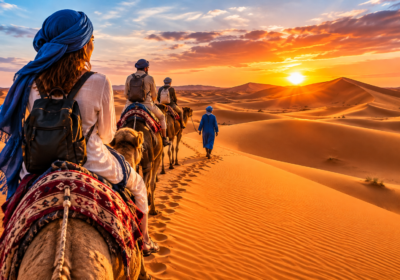
Can You Combine the Imperial Cities with the Sahara Desert?
Yes, it is possible to combine a tour of Morocco’s imperial cities with a Sahara Desert adventure.
An itinerary of 10–14 days may allow travelers to visit Marrakech, Rabat, Fes and Meknes before continuing toward the southern regions.
Additional destinations may include:
- The Atlas Mountains.
- Ziz Valley.
- Merzouga and the Erg Chebbi dunes.
- Todra Gorge.
- Ouarzazate.
- Ait Ben Haddou.
This type of journey provides an opportunity to discover both Morocco’s historic cities and its spectacular desert landscapes.
Careful planning is important because the distances between regions can be considerable.
Explore Morocco’s Imperial Cities with Travel Morocco Guide
Morocco’s four imperial cities offer an extraordinary journey through centuries of history, architecture and traditions.
Marrakech captivates visitors with its markets and historic palaces. Fes preserves an exceptional cultural heritage. Meknes reflects the grandeur of Morocco’s imperial dynasties, while Rabat combines historic charm with modern urban life.
Exploring these destinations is one of the best ways to understand the country’s rich cultural identity.
With Travel Morocco Guide, you can discover travel itineraries that introduce you to Morocco’s imperial cities, beautiful Atlas Mountains and breathtaking Sahara Desert.
Explore our Morocco tours and find the perfect itinerary for your next unforgettable journey.